
Put on a show without going broke.
Let's walk through the platform as the fictitious band Crimson Alibi. Like you, we know venues are squeezed and promoters have pulled back. Nobody is coming to book us so we put the show on ourselves. The playing is the easy part. The admin before it is not. Gig Fling is a free tool for our admin.
Check the real cost upfront
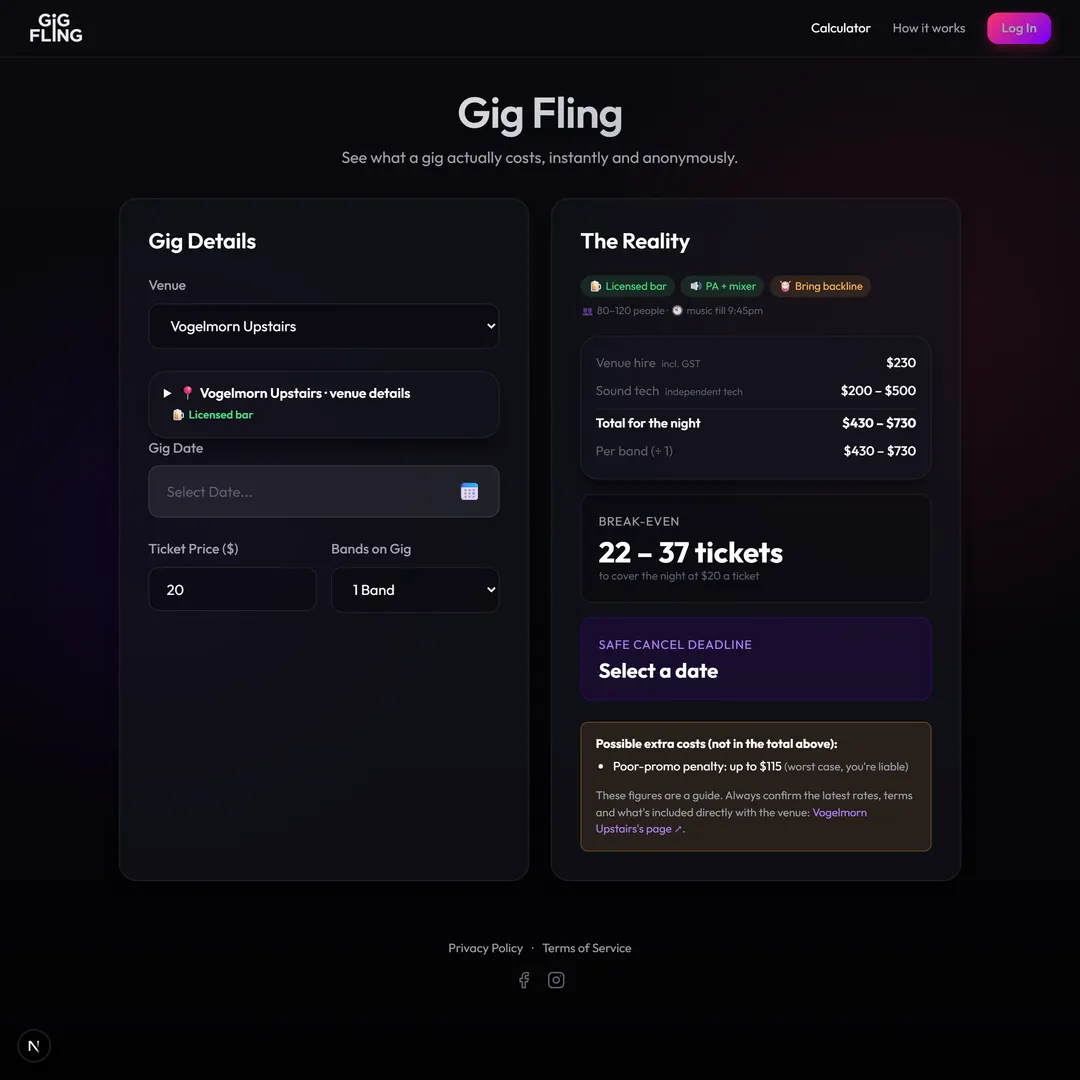
- On Gig Fling, we pick a venue and a date to see the hire cost, sound fees, GST, and our break even ticket target.
- No account or sign up needed. It works immediately even if nobody else in our scene uses it yet.
- The calculator does not guess numbers. If sound tech costs $200 to $500 it shows us the full range so we know what we are in for.
See what else is happening
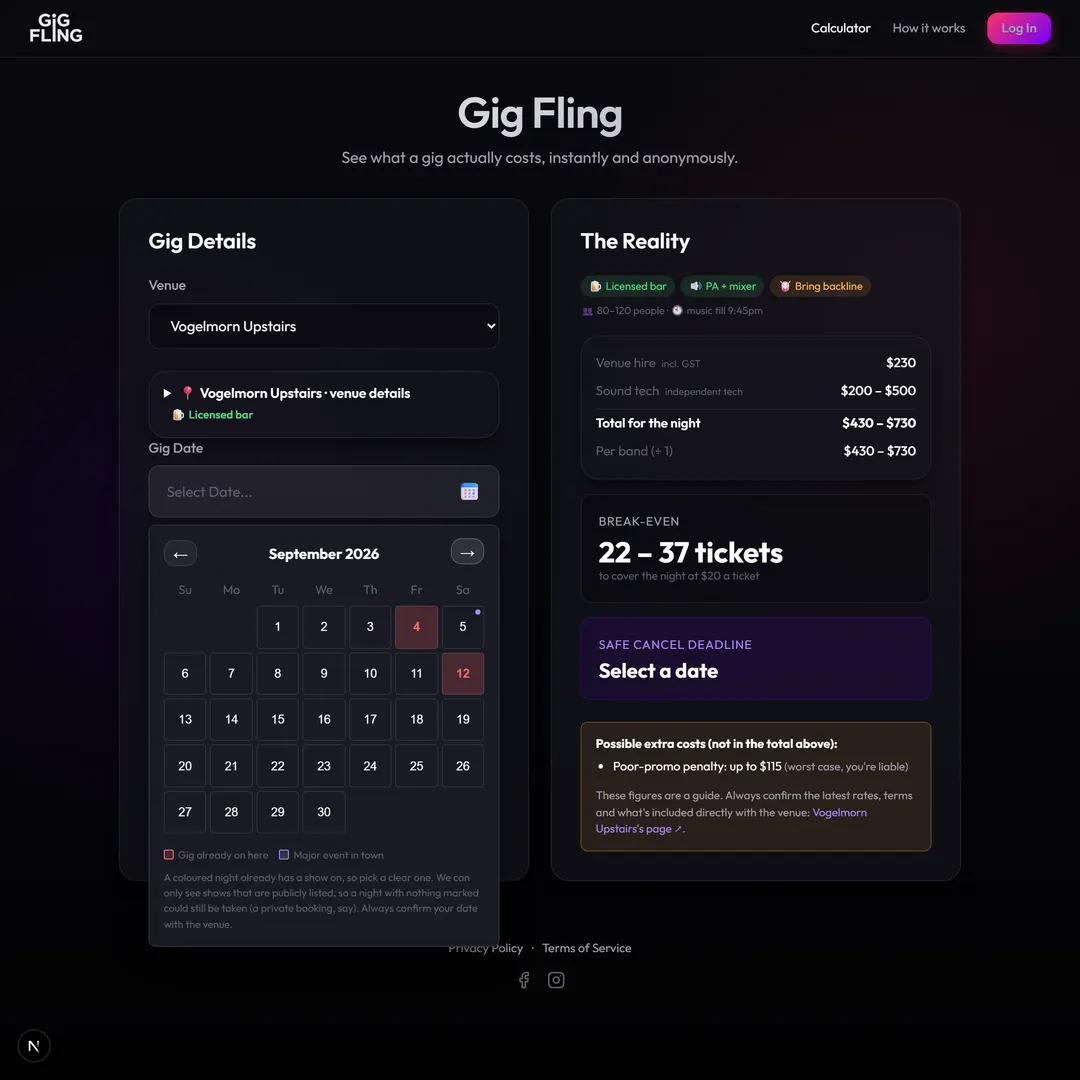
- The calendar flags the nights we would rather avoid booking.
- Red means the room is taken. Better to find out now than after we contact the venue.
- Purple means a major event is on. If a big festival is in town our crowd is probably there.
- It pulls real public listings weekly. If a night is clear it means there are no major clashes on the radar.
- It only flags the stuff that actually competes for our crowd so we are not overwhelmed with noise.
Venue specs without the hunt
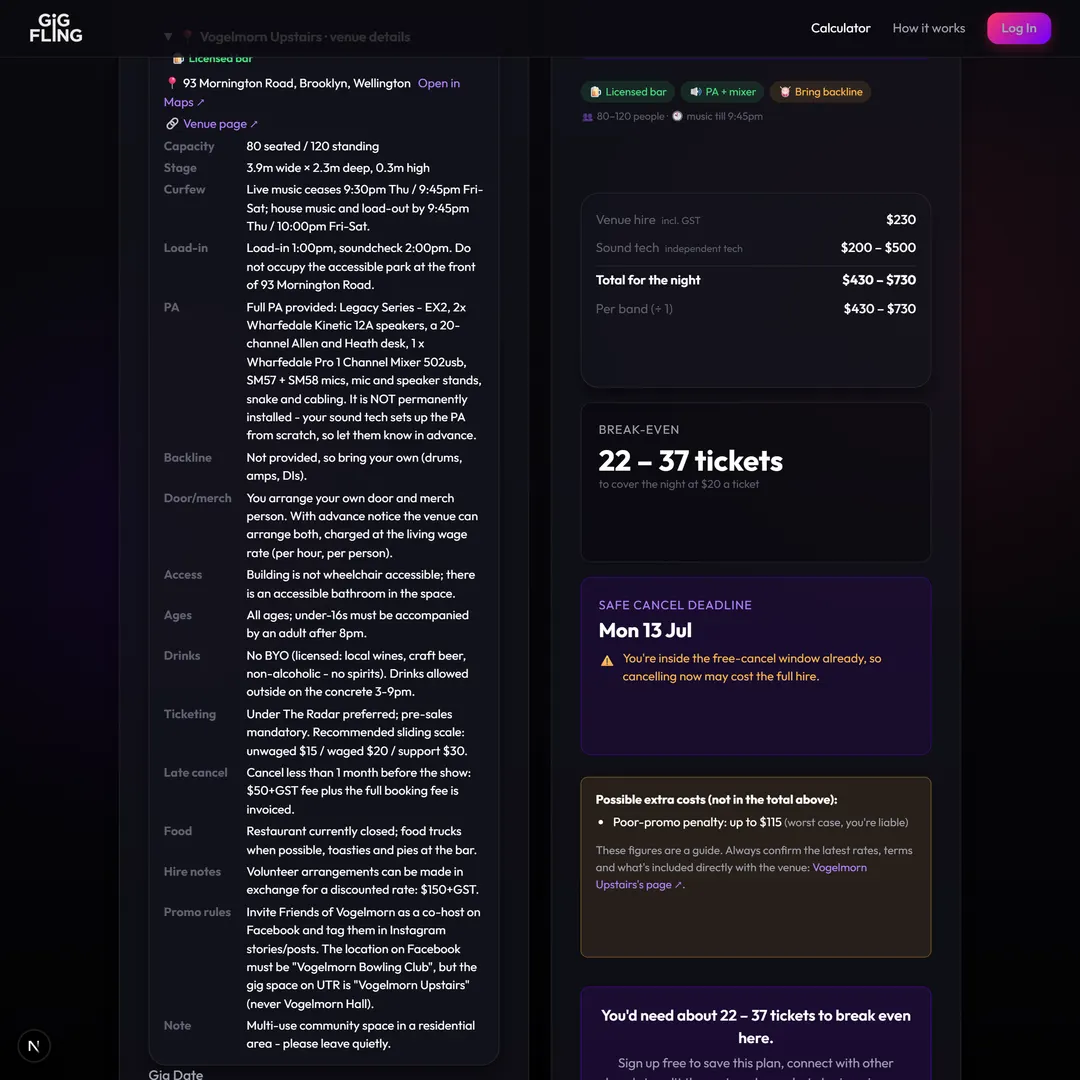
- It gathers the venue's public info like capacity, stage size, curfew, and load in times all in one spot.
- Gear details: We know exactly what PA and mics they have before our sound tech shows up.
- We see the rules on door staff, merch, age limits, and ticketing preferences.
- Cancellation fees are visible upfront. Pick a date, and the calculator shows the exact safe cancel deadline so we know what we owe if we pull out late.
- These are copies of their public packs.
1. Put your act up
Every band platform fills up with fakes, dead projects and covers duos from 2011. We do not trust what we are looking at and the whole thing quietly dies.
Our real draw with no pressure
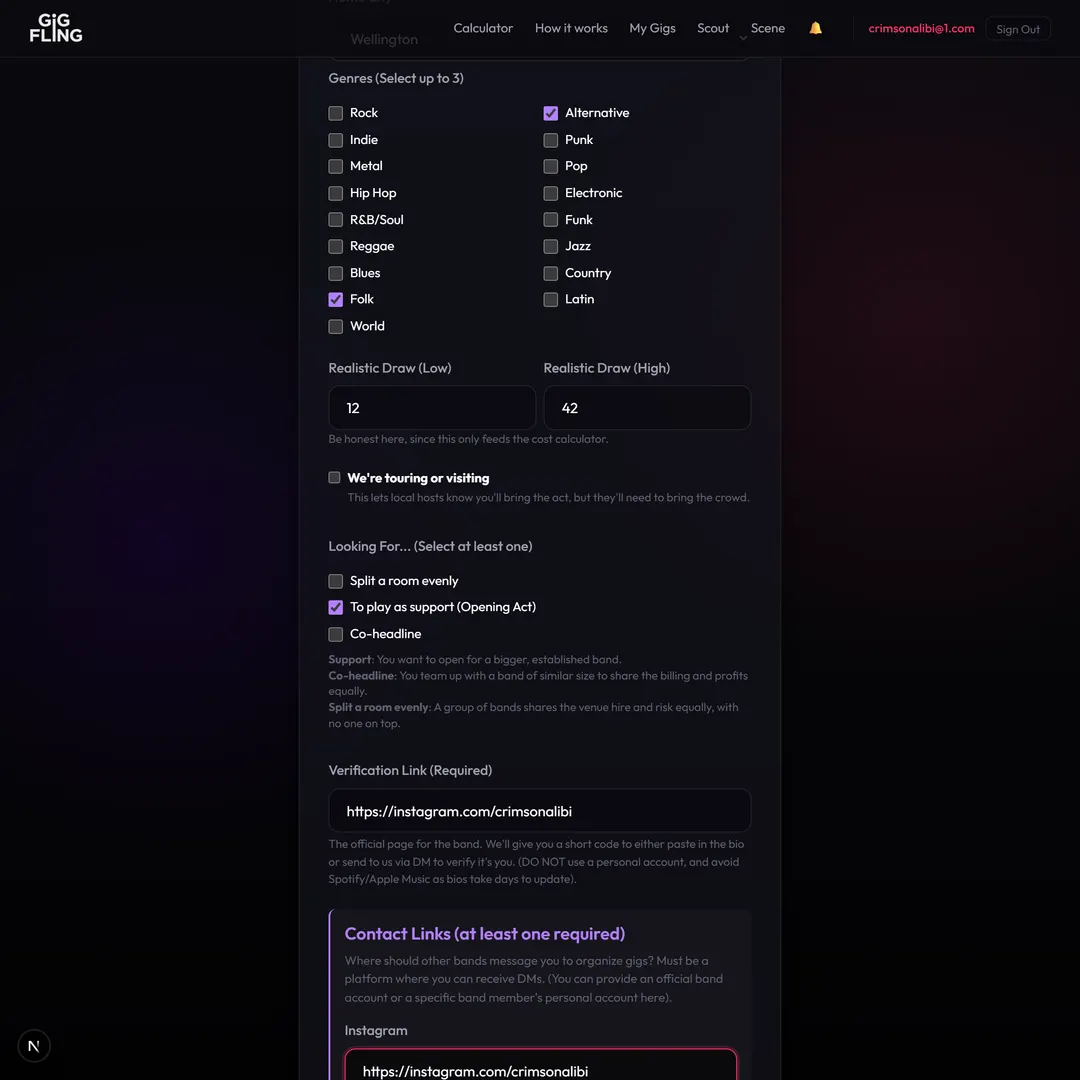
- We set our name, city, genre, and how many people we actually pull as a range.
- It never uses this number to rank or score us. It is just for the math to see if a gig covers its costs.
- Faking it will not help us get gigs. It will just make our break even math wrong.
- We give one social link for verification and one way to reach us like Instagram or Facebook. That is how bands message us when we make a connection.
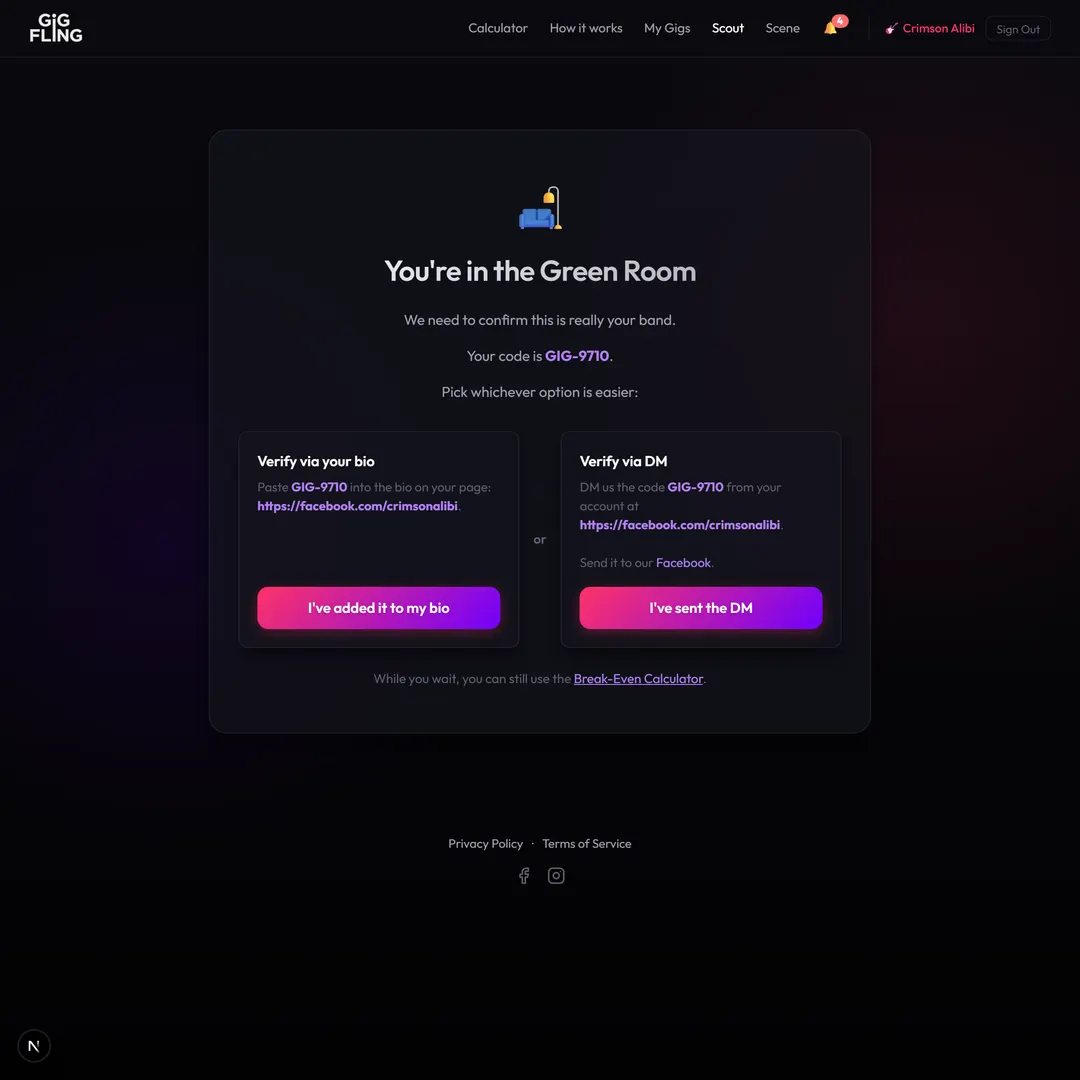
Real humans verify us
- We get a unique code. We paste it in our bio or DM it to them from our social account.
- A real person checks it to confirm we are an actual local act.
- No algorithms and no fake profiles. Every card we see on the deck is a real and verified band.
2. Find bands who are free when we are
“Are you free in June?” sent to ten bands then three weeks of waiting for replies and half of them were never free anyway. We do this every time.
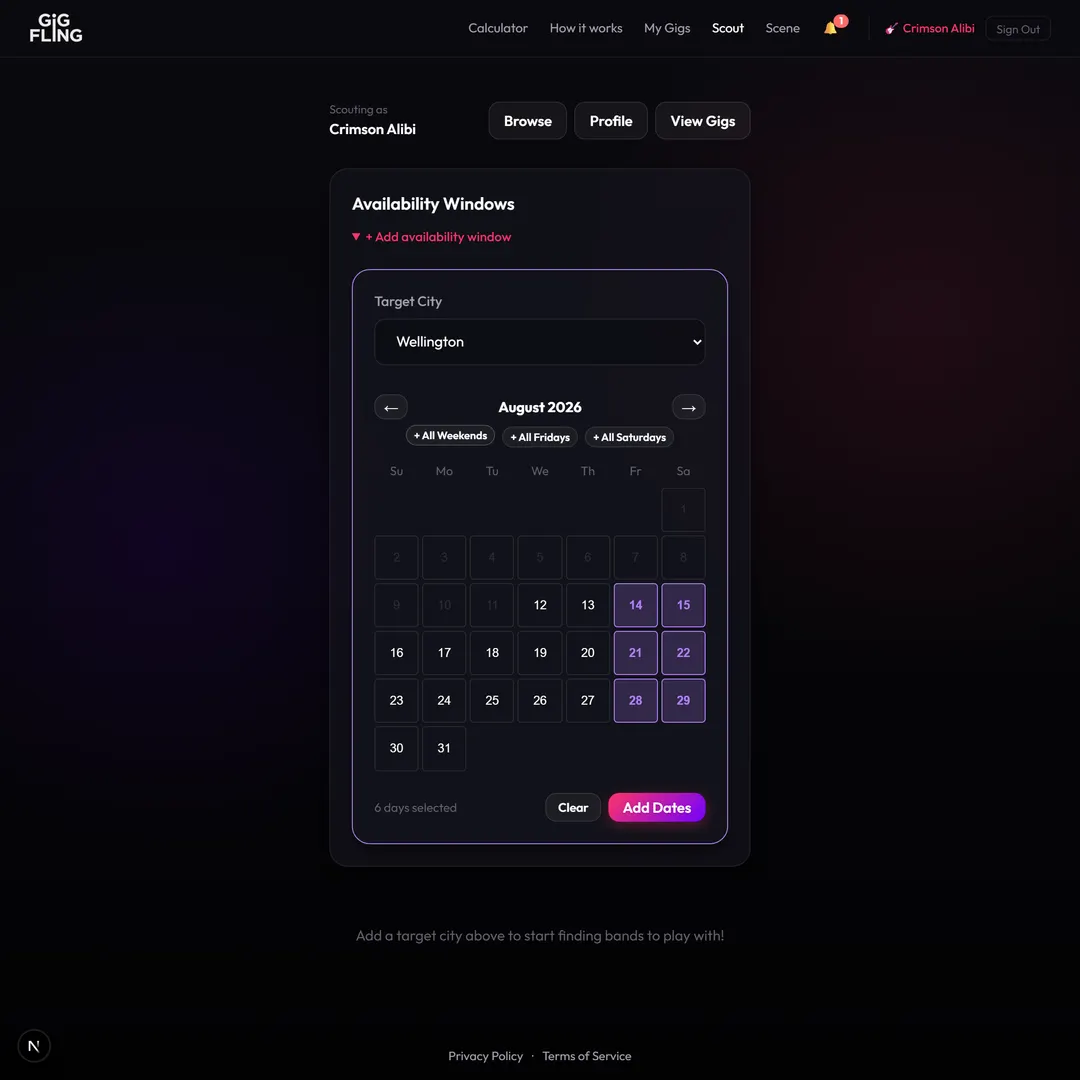
Set our dates once
- We pick a date window we could play. We use the + All Weekends shortcut if it is easier.
- It is not a commitment but just an honest indication of when we are free.
- Once set we only see bands who are also free on our dates. No more messaging ten bands just to find out no one is available.
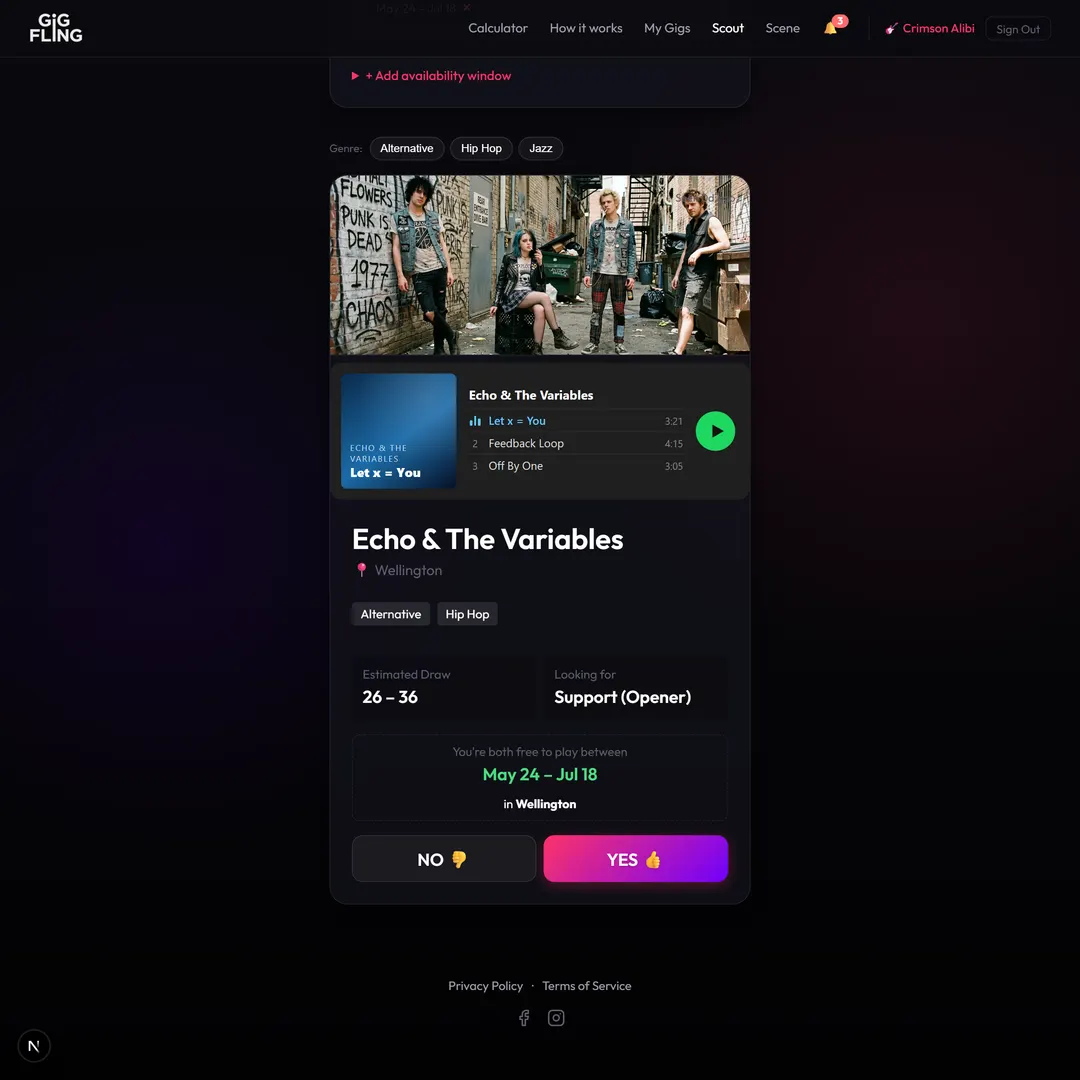
Bands ready to play
- Every card is a vetted band in our city who is free when we are.
- We check out their draw, what gig type they want, and their music.
- We select YES 👍 or NO 👎. It is totally private. Nobody knows if we pass on them.
- We use the genre filter to dial in exactly the sound we want for the bill.
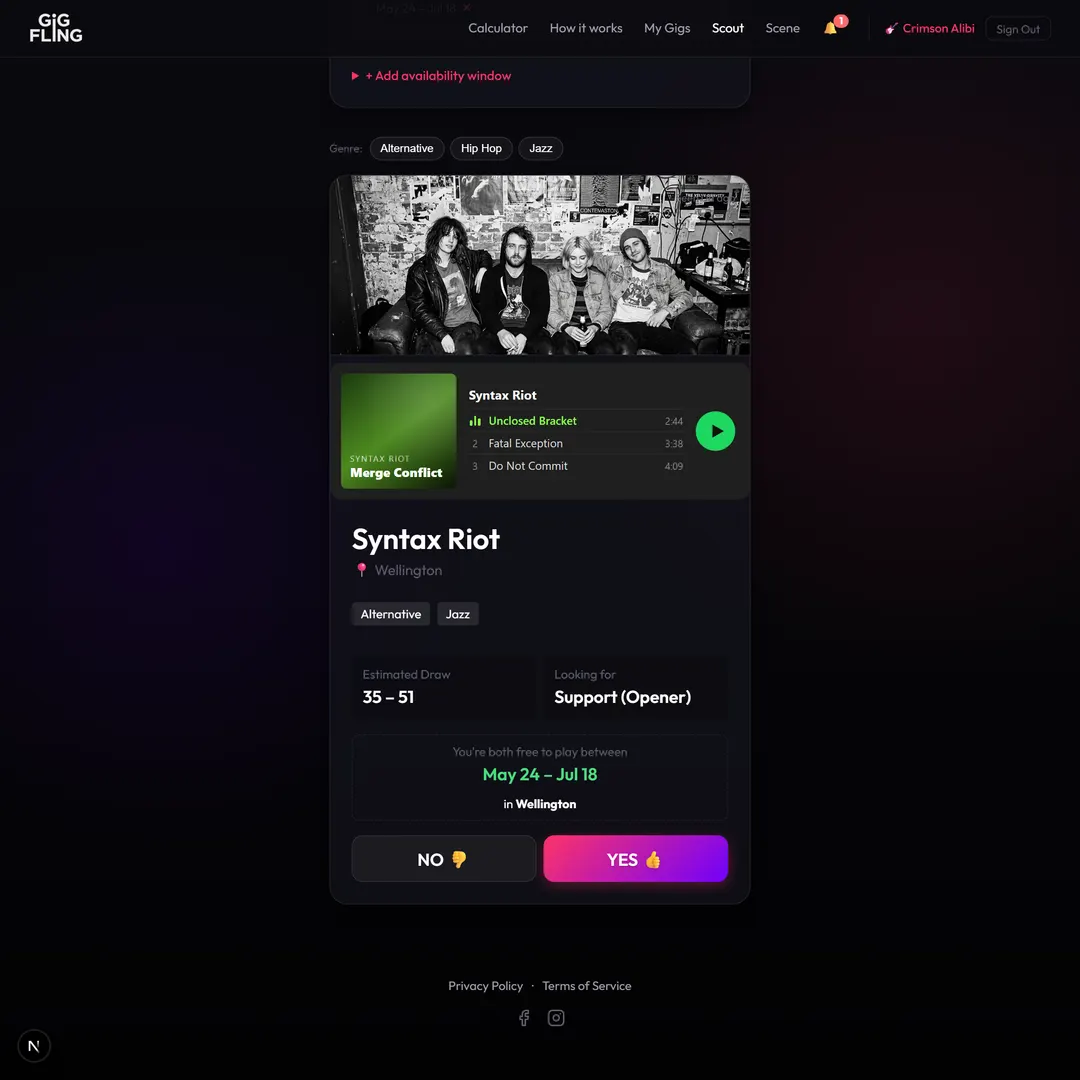
Enough to actually decide
- Their draw range, what they are looking for, and their dates next to ours.
- “Local hosts the room” tells us whether they bring a crowd here or are visiting and need one.
- A touring band is labelled as touring rather than shown as if it has a local following.
Or just take a slot on someone else show
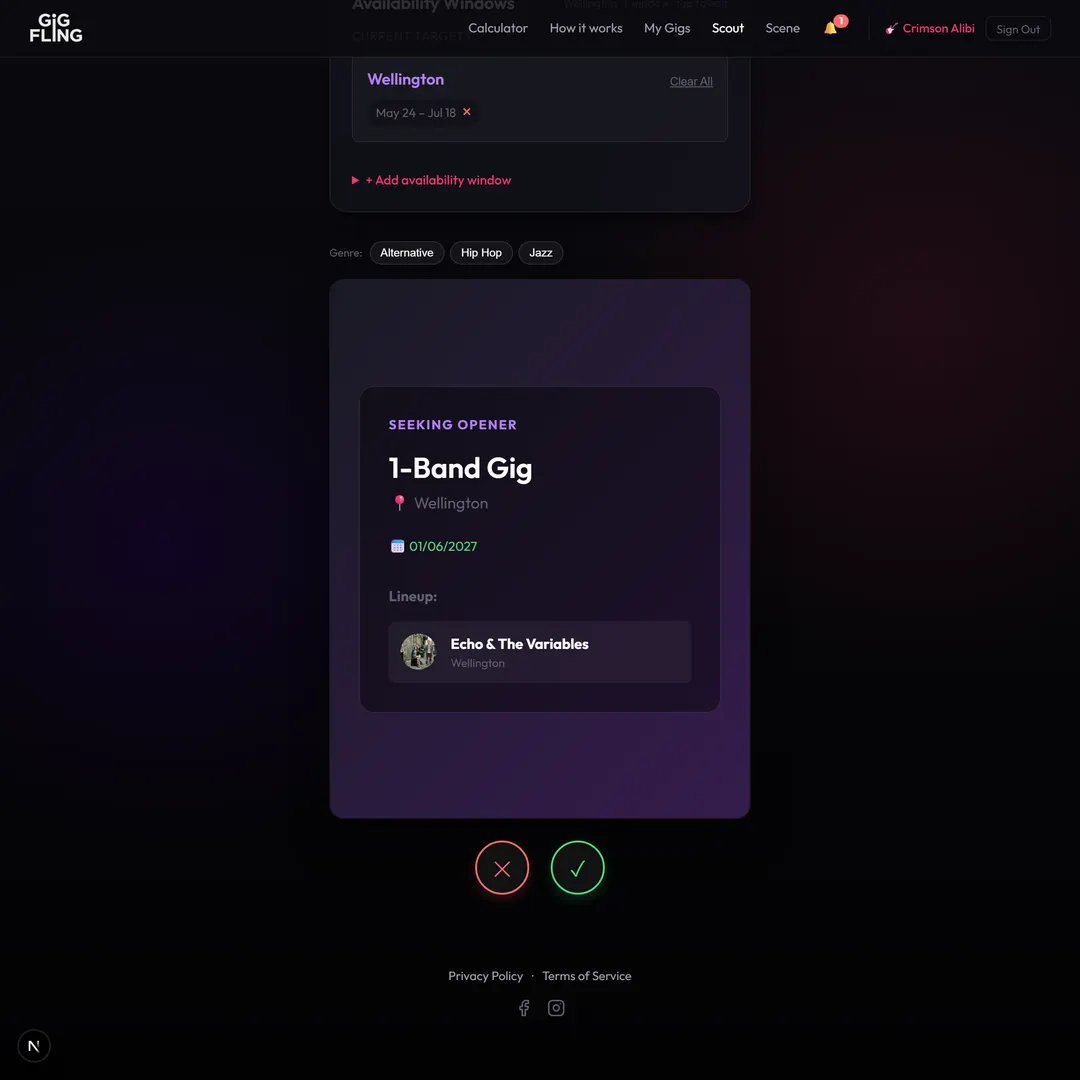
- Some cards are not bands. They are gigs already in motion with a venue and a date looking for another act.
- Seeking Opener means what it says. We say yes and we have applied. The host takes it from there.
- We do not have to organise anything to use this. Sometimes the fastest gig is someone else show.
3. When it is mutual we get their details
Cold messaging a band we have never met mostly gets ignored. We are asking a stranger for a favour without knowing whether they are interested.
The feeling is mutual
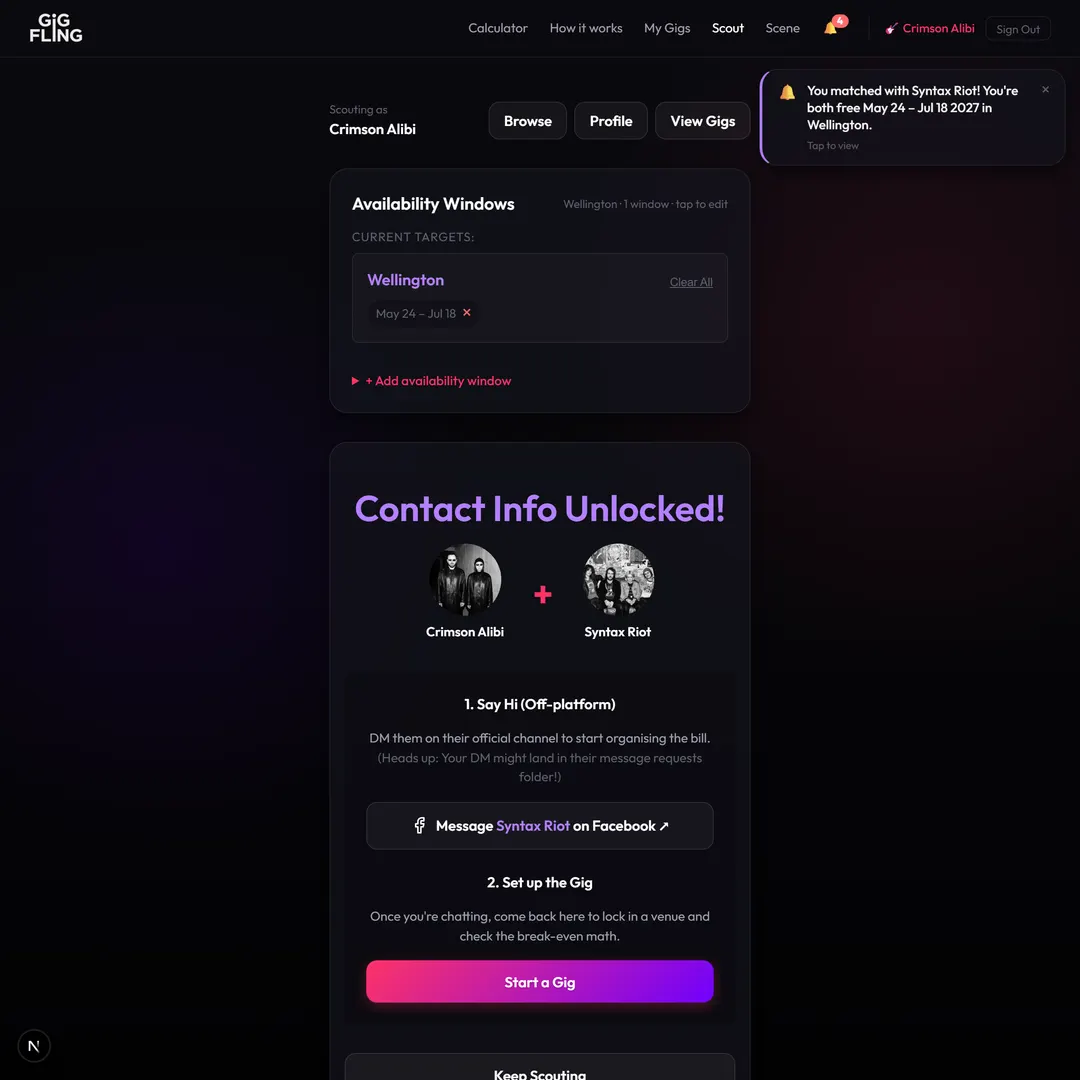
- Syntax Riot selected YES on us days ago but we were not told.
- When we select YES back we have got a connection. Two bands who both want to play together with dates that align.
- It is double opt in. Nobody gets explicitly rejected because nobody knows who passed on them.
Straight to the point
- We instantly get their real contact channel like Instagram or Facebook.
- It does not trap us in a proprietary chat system. There is no Gig Fling inbox to check.
- Our overlapping free window is right there on the screen giving us the perfect icebreaker.
- When we are ready to lock it in we click Start a Gig to handle the booking admin.
4. Start the gig
Four bands in a group chat with nobody in charge and the venue never gets booked because everyone assumed someone else was doing it.
One band drives it
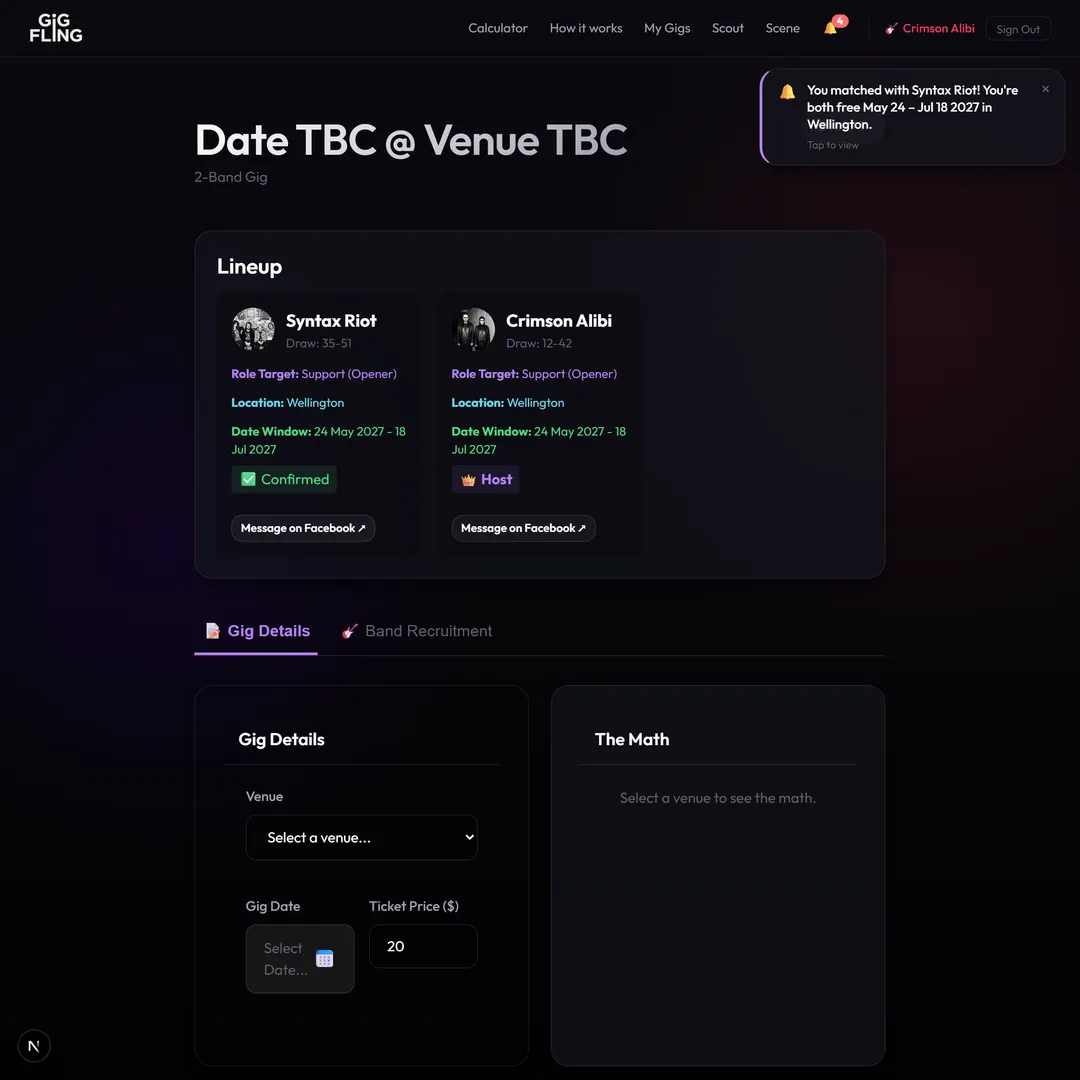
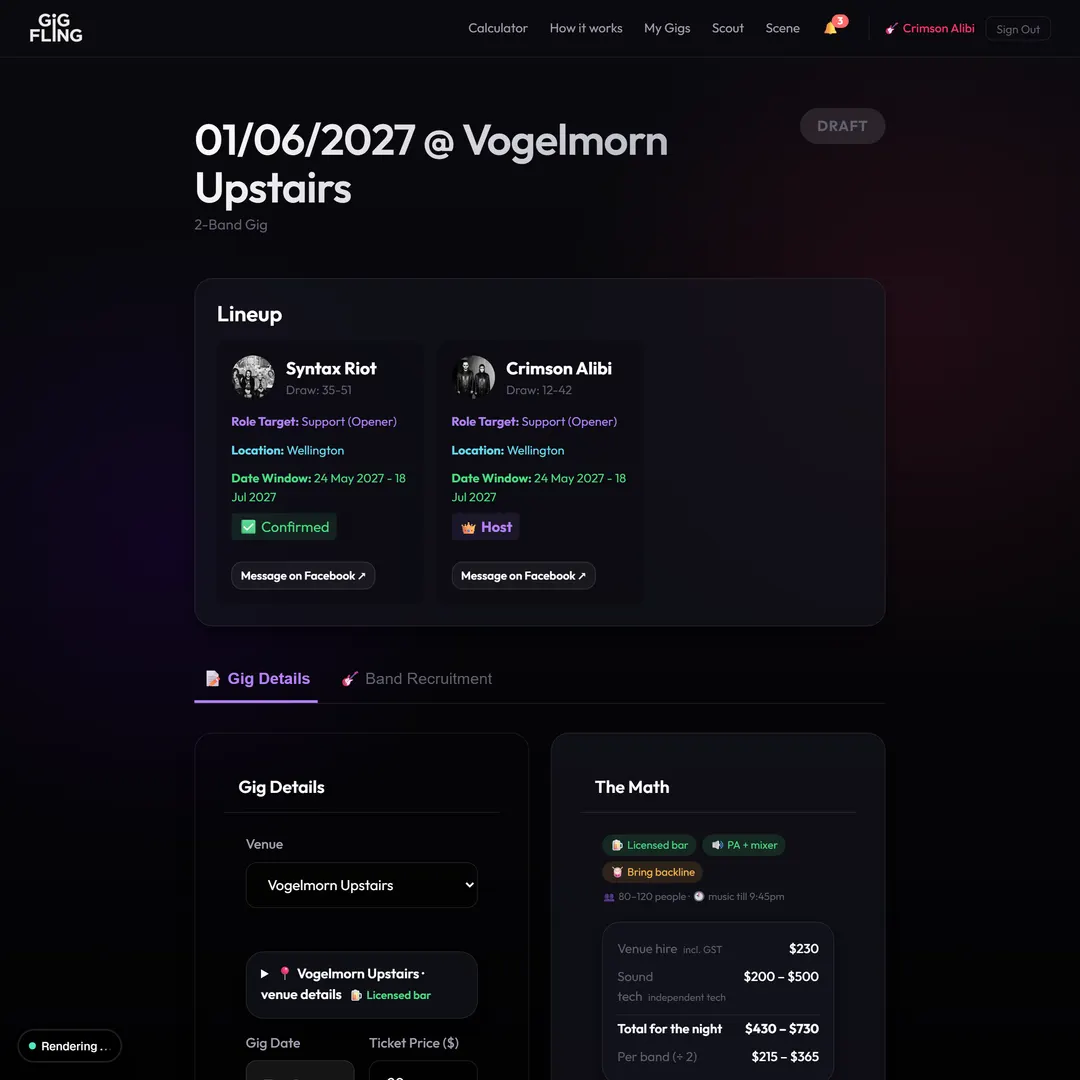
- Both bands are on the bill. One of us is the host and picks the venue, the date and the price.
- Everything starts TBC. This is a shared plan and not a commitment.
- The window we agreed is frozen here so months later nobody argues about what was said.
- If the host goes quiet for 3 days anyone else on the bill can take over so one person going off the grid does not kill the gig.
5. See the real costs upfront
Usually we only find out the true cost of a gig after it has happened, when the venue invoice lands. If the door money does not cover it, someone quietly eats the difference.
Real venues and real rates with GST included
- The Wellington venues are loaded from their published hire packs and not guesses.
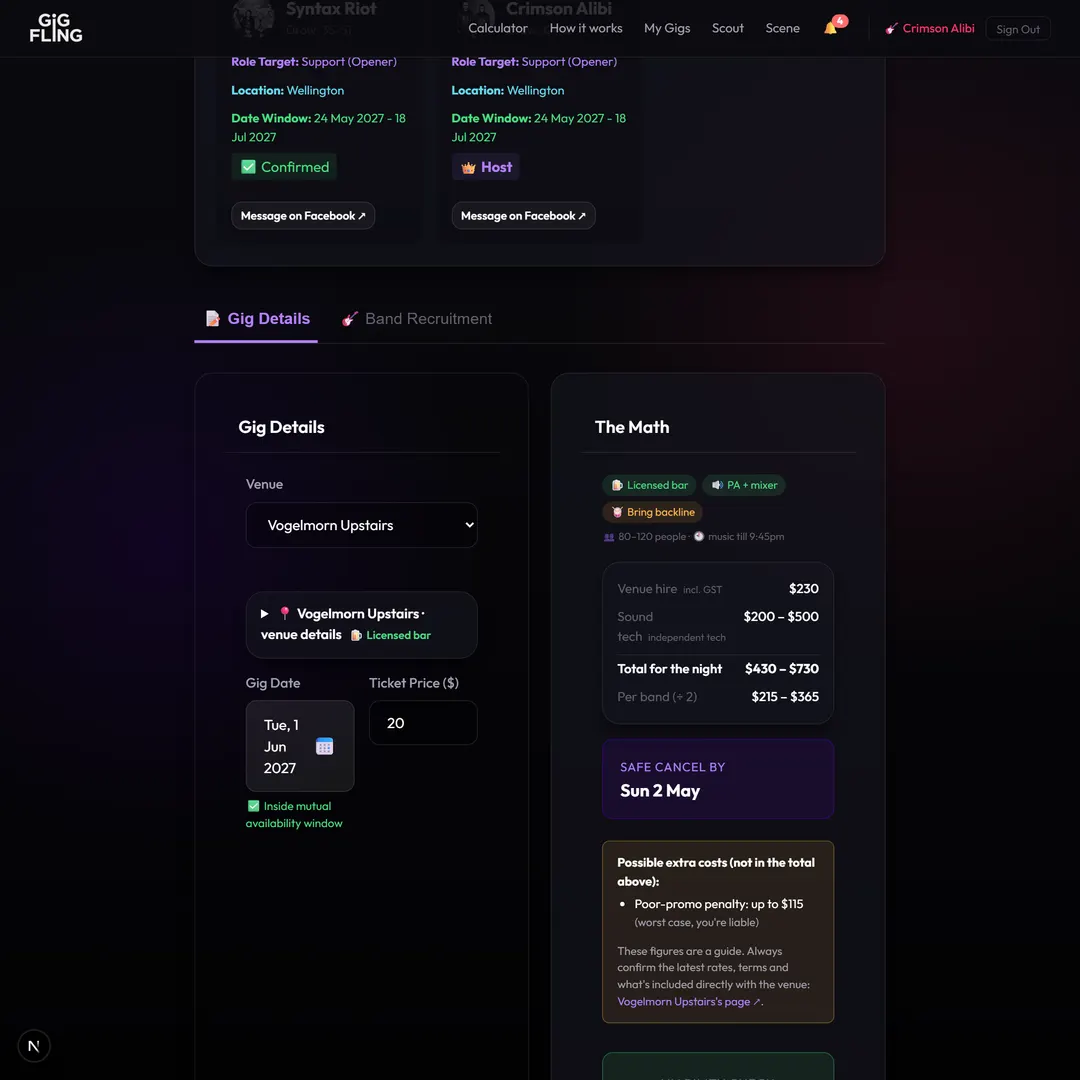
- Vogelmorn quotes its hire plus GST so the app adds it. $200 becomes $230. Every number on screen includes GST so a plus GST room and a community hall can be compared directly.
- The venue tags show exactly what is included. Licensed bar, PA and mixer, bring your own backline, capacity, and the curfew.
- We pick our date and it checks the date sits inside the window we both agreed.
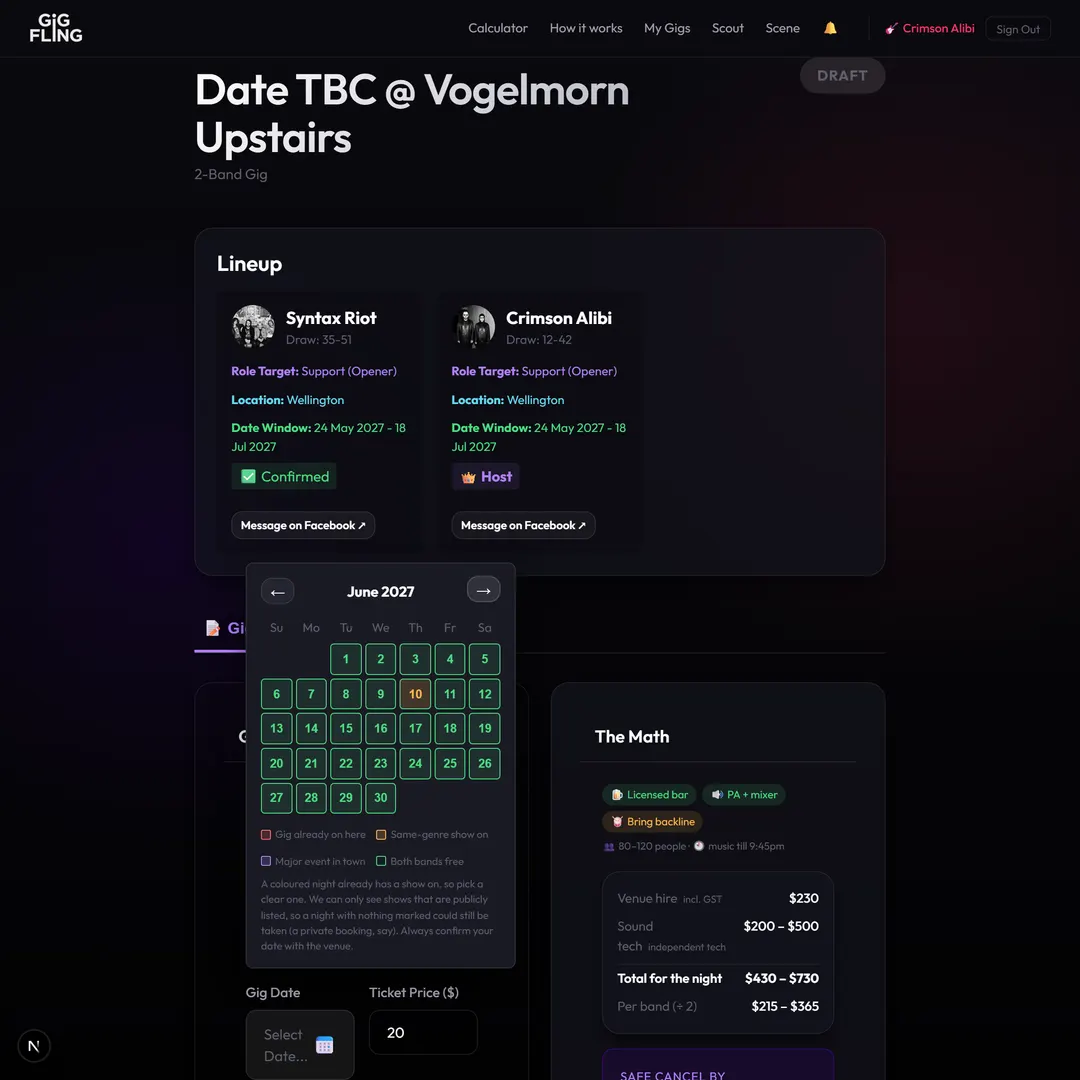
See who is free and what is on
- The same grid now with our lineup shared free window outlined in green. Every night both bands already said they could play.
- Amber means a same genre show is on. The kind of night that splits our crowd so we can steer around it.
- Red and purple still apply too. The room already booked or a major event in town.
- We pick a night inside the green and we know it works for everyone before we lock it in.
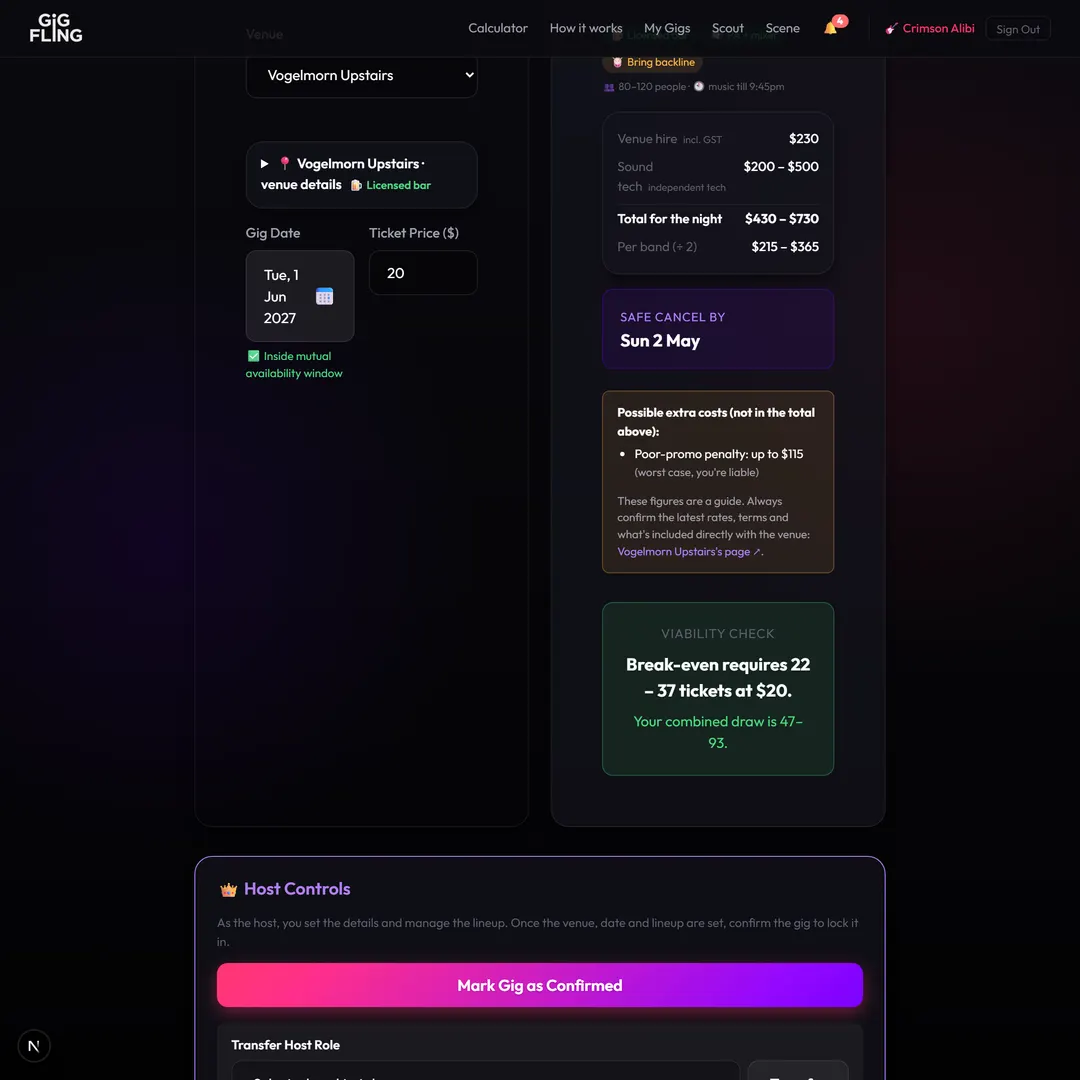
What the night needs to sell
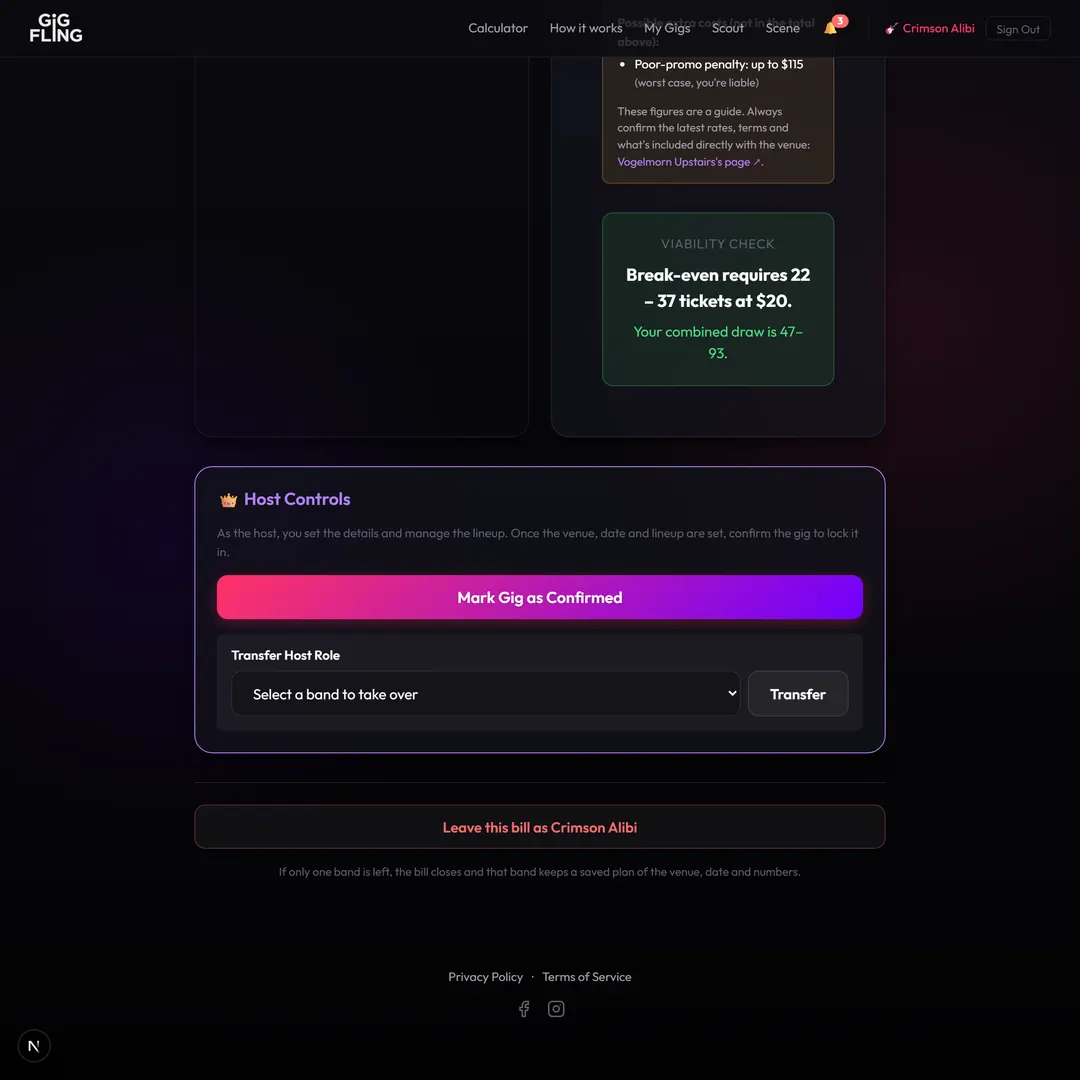
- Total Cost: $430 to $730. This includes venue hire and sound tech $200 to $500. Between two bands that is $215 to $365 each.
- Break even is 22 to 37 tickets at $20. Our combined draw is 47 to 93 so we should comfortably cover costs if we both bring our regular crowd.
- Safe cancel by Sun 2 May. Cancel before that date and it costs us nothing. After it we owe the venue.
- The $115 poor promo penalty is listed separately. It is only charged if we do not promote the gig.
6. Fill the bill
Two bands is often not a night. We need a third so we are back to asking around and the ones we know are busy.
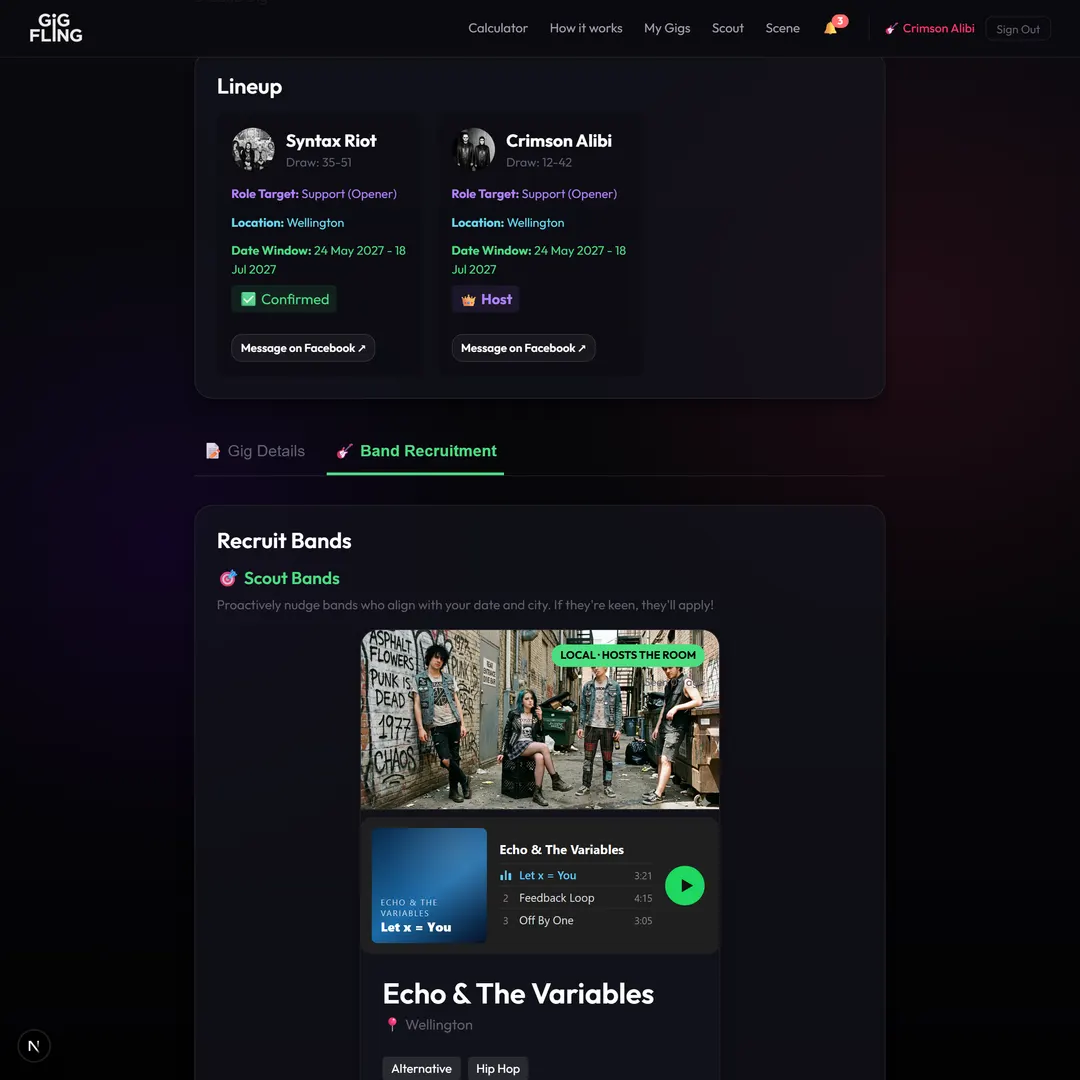
Start as a duo and grow when we are ready
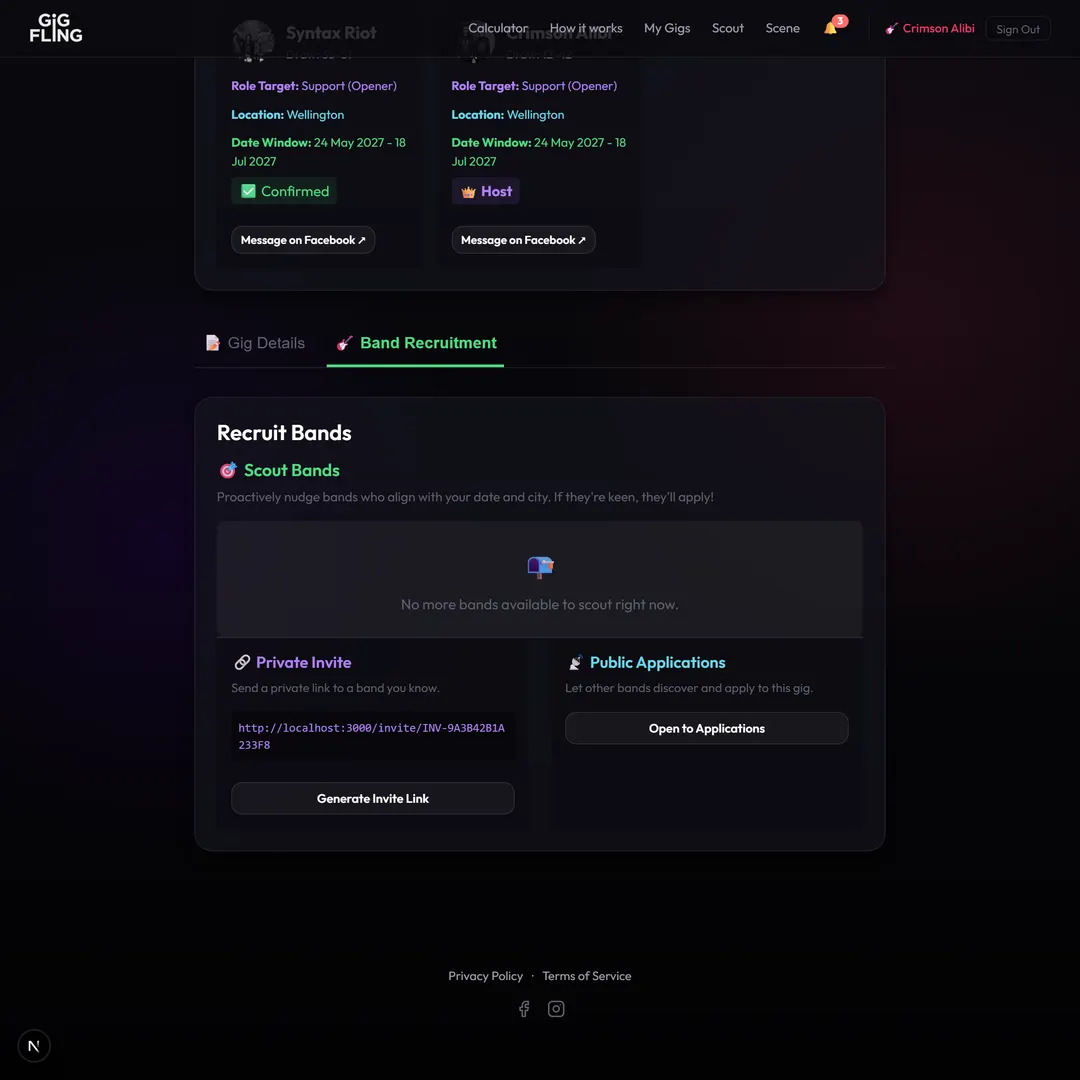
- When we want more there are three ways. Scout bands who fit, send a private link to people we know, or open it up and let bands apply.
- It caps at four bands. Past that nobody gets a proper set and the split stops being worth it.
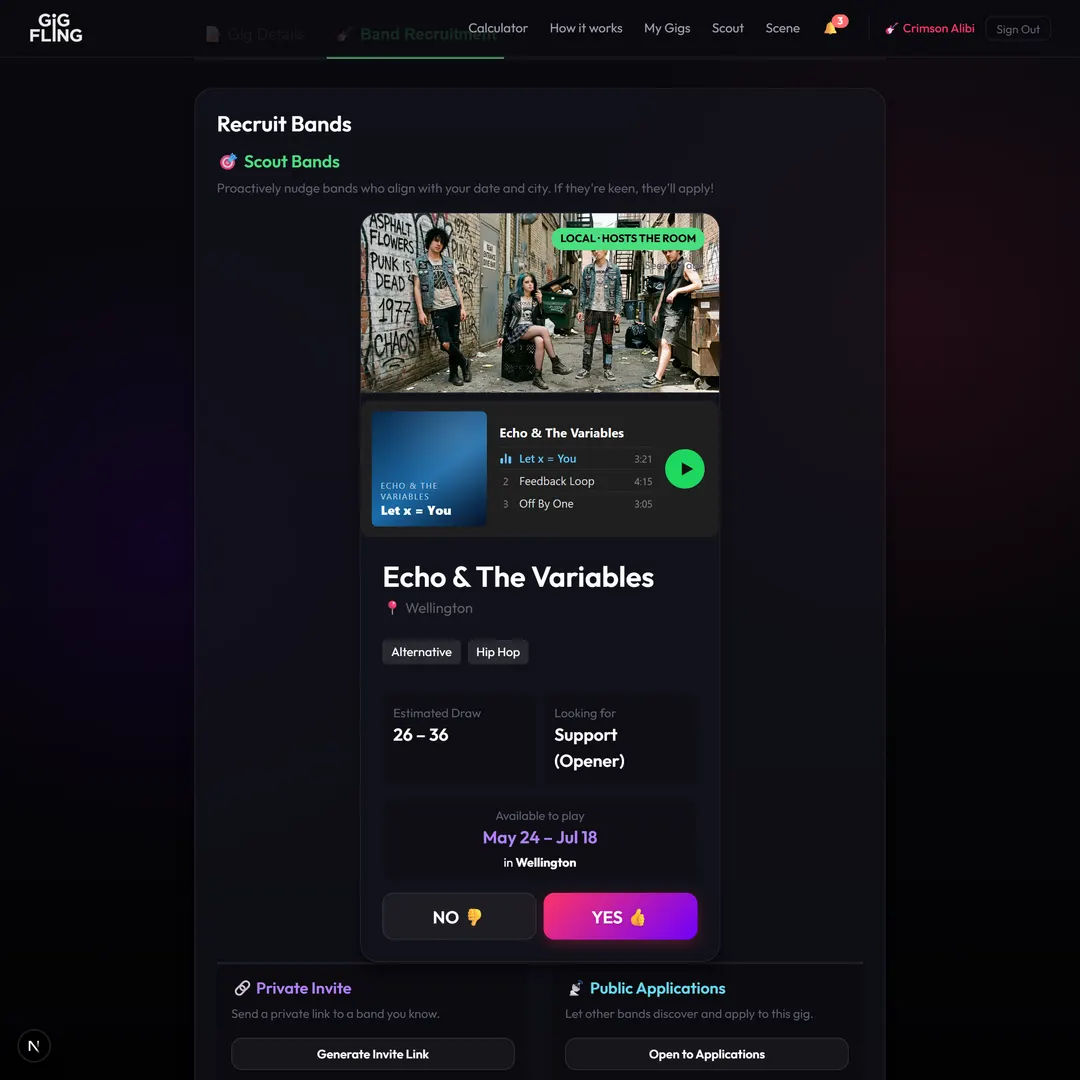
Only acts who already fit
- We are only shown bands free on our date in our city. The filtering has already happened.
- Their draw is on the card so we can see what it does to our break even before we ask.
- A nudge is an invitation not an addition. They still choose.
- If they pass that is final. We cannot nudge them again for this gig.
When we already know who we want
- Private invite. A single link we send directly. They join without touching the deck.
- Open applications. Our gig shows on the Scout Deck as a card. Bands apply to us and we accept or decline.
7. Lock it in
Nobody promotes a show they are not sure is happening. Everyone waits and the poster goes up ten days out and the room is half empty.
One button once the gig is real
- The button only works once there is a venue and a date so we cannot confirm a gig that does not exist yet.
- The host calls it. There is no committee and no round of approvals to wait on.
Everyone can start selling it
- The gig reads CONFIRMED and the terms lock. Every band on the bill knows it is real and can start promoting now rather than ten days out.
- Confirming is a signal to each other and nothing more. We promote on our own channels to our own people.
- Then we play. The money is ours. We sell tickets wherever we like. Gig Fling never touches it and takes no cut.
The deal
Most tools that get between bands and their gigs end up taking a cut or holding the money or quietly owning the audience. That is the thing we are trying to get away from.